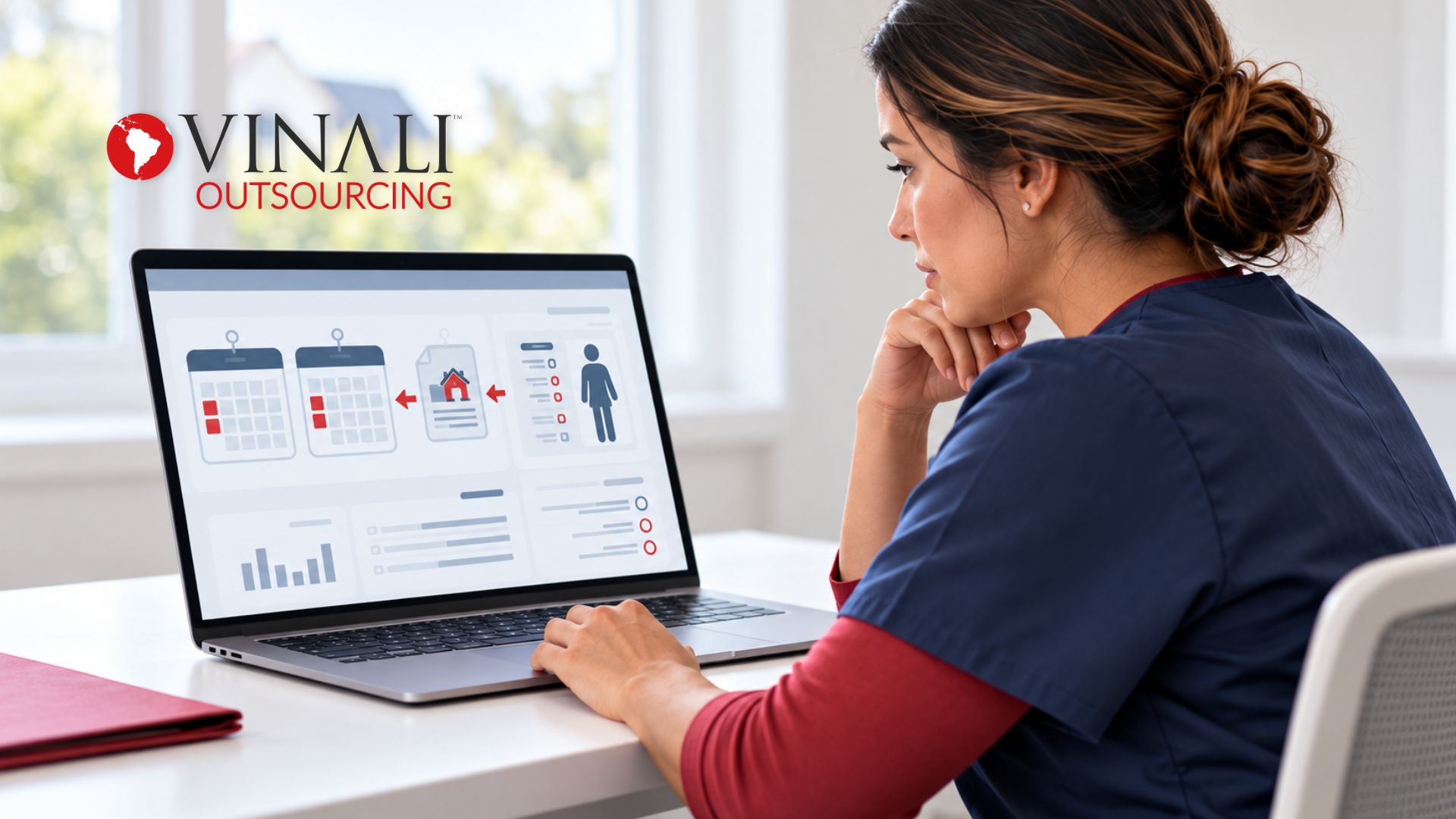

If you're looking into outsourcing nursing services for your home health agency, the first thing worth clearing up is what a remote partner actually takes on. It's not the hands-on visit itself. That stays with your field clinicians. What a nearshore team like Vinali handles is the remote clinical support behind the scenes: care coordination, OASIS and chart review, documentation, and quality oversight. Done right, it takes real workload off your clinical staff without touching the part of the job that has to happen in a patient's home. Already sure this is the direction you want? Fill out this form and we'll follow up with what fits your agency. Still working through it? Keep reading.

What Does It Mean to Outsource Nursing Services for Home Health?
It means bringing in a partner to handle the remote support functions behind your clinical operation, not the in-person patient care itself. Think care plan coordination, OASIS and chart reviews, documentation support, and quality oversight, the kind of work that keeps your agency organized and compliant without requiring anyone to physically be in the patient's living room.
What Roles Typically Fall Under Outsourced Nursing Services?
A US RN-licensed clinical coordinator handling care coordination and chart oversight, documentation specialists supporting chart accuracy, and quality review staff checking that OASIS assessments and charting meet payer and regulatory standards. Vinali's own Home Health teams include Registered Nurses working in these coordination and oversight roles specifically, alongside referral and scheduling coordinators. Most agencies mix and match these based on where their in-house team is actually stretched thin.
Where Does This Fit Alongside Your In-House Clinical Team?
It sits behind them, not in place of them. Your field nurses still handle every patient visit and every clinical decision that requires being physically present. An outsourced team picks up the coordination and documentation load that tends to pile up around those visits, so your clinical staff spends more time with patients and less time on paperwork.
How Much Does It Cost to Outsource Nursing Services?
A few factors move the price more than anything else. The complexity of the work is the biggest one: straightforward documentation support costs less than coordination work overseen by a US RN-licensed clinical coordinator, since that role carries more judgment and more back-and-forth with providers and payers. Patient volume and how many hours of coverage you need (business hours only versus after-hours and weekends) push the price up or down from there. Where the team is based matters too. Fully U.S.-based support tends to cost the most, while nearshore support usually lands well below that, closer to what offshore providers charge but without the same coordination trade-offs.
What often gets missed in a straight cost comparison is what happens when this work falls behind in-house. Delayed OASIS reviews and documentation gaps can affect reimbursement, and that cost rarely shows up on a staffing budget line until it's already a problem.

What Are the Signs Your Home Health Agency Needs to Outsource Nursing Support?
Usually it shows up as your in-house team spending more time on documentation and follow-up than on the work that actually needs their clinical judgment. A few other signs worth watching for:
- OASIS and chart reviews falling behind as patient volume grows
- Care coordination between visits slipping, with follow-ups getting missed
- Field staff pulled into administrative work that keeps them from patients
- Documentation gaps showing up in audits or affecting reimbursement
If a couple of these sound familiar, it's usually not about hiring one more person in-house. It's about the coordination and documentation workload outgrowing what your current team can absorb alongside patient care.
What Mistakes Do Agencies Make When Outsourcing Nursing Services?
Treating every function the same is the big one. Outsourcing documentation support isn't the same as outsourcing care coordination, and a provider who's strong at one isn't automatically strong at the other. A few other mistakes that come up:
- Not confirming whether coordination work is actually overseen by a licensed Registered Nurse or handled without that credential
- Assuming quality oversight can run on autopilot once it's handed off
- Skipping a real conversation about how issues get escalated back to your clinical team
That compliance piece deserves its own explanation.
Why Does Compliance Matter When You Outsource Nursing Support Functions?
Because even coordination and documentation work involves protected health information: patient names, diagnoses, care plans, insurance details. This isn't a low-stakes administrative task sitting far from patient care, it touches the same sensitive information your clinical team handles every day.
HIPAA applies to every piece of that information, and any outsourcing arrangement involving PHI should include a signed Business Associate Agreement (BAA), not just a general confidentiality clause. Ask any provider you're considering to show you real documentation, not a policy statement on their website.
Nearshore vs. Offshore Nursing Support Outsourcing: Which Is Right for You?
For work that involves real-time coordination with providers, patients, and payers, nearshore usually makes more sense. A team working your hours, with clear communication and minimal time-zone lag, can actually follow up on something urgent when it matters. Offshore providers can cover the same hours, but doing it usually means staffing overnight shifts on their end, which adds a layer of coordination risk that doesn't show up until something urgent actually happens.
A nearshore team in Latin America operates inside your business day and tends to function more like an extension of your clinical operation than an outside vendor working on a delay.

How Do You Choose the Right Partner to Outsource Nursing Services?
Start with whether the provider actually understands home health specifically, not healthcare outsourcing in general. Worth checking:
- Real experience with home health workflows, OASIS, and payer documentation requirements
- A US RN-licensed clinical coordinator overseeing the work where that credential matters, not just administrative staff
- A signed BAA and clear data security practices, not just a HIPAA mention
- Coverage that matches when your agency actually needs support
- A defined escalation process for anything that needs your clinical team's judgment
Whatever's pushing you to look into this now, ask the provider to show you their process directly, not just take their word for it. At Vinali, our nursing support services are built around home health specifically, backed by SOC 2 Type II and ISO 27001 certifications, with compliance handled as a starting point, not an afterthought.
If you want to talk through what this could look like for your agency, contact our team here and we'll walk you through it.
Disclaimer: Statistics and industry figures referenced in this article come from external sources considered reliable at the time of publication and are provided for general informational purposes only.