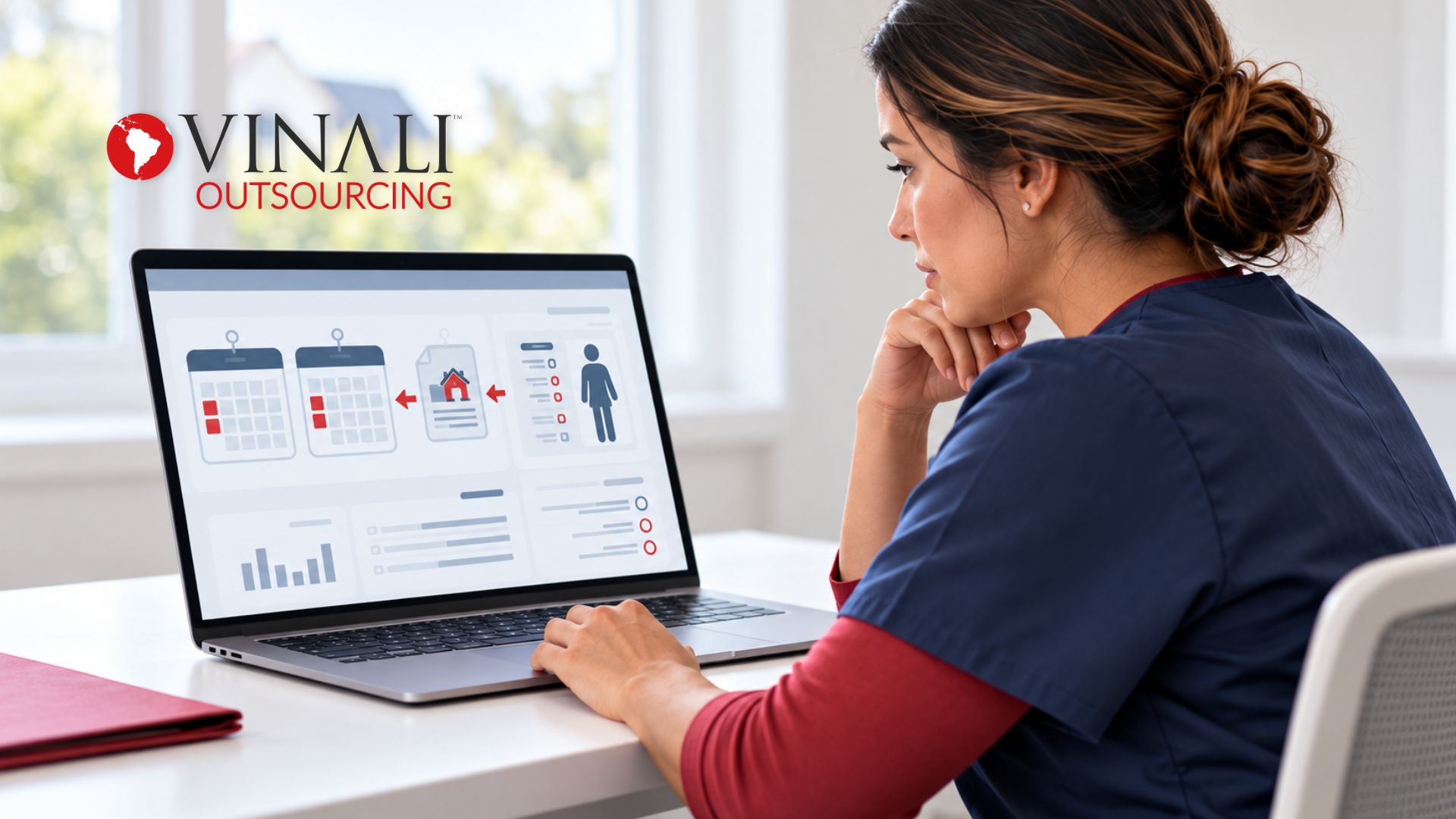

Home care staffing solutions are outsourced programs that place caregivers, clinical coordinators, and administrative staff into your agency without you having to run the hiring pipeline yourself. Agencies turn to them for one simple reason: posting a job, waiting for applicants, and training people in-house isn't keeping pace with demand or with how fast caregivers leave.
If you're already losing staff faster than you can replace them, fill out this form and one of our specialists will walk you through what a staffing partnership could look like for your agency. If you'd rather understand the full picture first, here's what these solutions cover and how they hold up in practice.

Why Are Home Care Agencies Turning to Staffing Solutions Now?
Because the math no longer works with an in-house-only model. The U.S. Bureau of Labor Statistics projects home health and personal care aide employment will grow by 847,300 jobs between 2025 and 2035. That's more new positions than any other occupation in the country, with a growth rate more than five times the average across all U.S. jobs.
That demand is colliding with a retention problem most agencies already know firsthand. Industry research from PHI puts caregiver turnover at roughly 70% to 80% within the first 100 days of hire, and each departure typically costs an agency somewhere between $2,600 and $5,000 in recruiting and training once you add it up. Agencies aren't just short-staffed. They're stuck re-filling the same roles over and over, which is exactly the cycle staffing solutions are built to break.
What Does a Home Care Staffing Solution Actually Include?
It typically covers the roles agencies struggle most to keep filled, not just caregiving shifts. Depending on the provider, a staffing solution can include:
- Caregiver coordinators and floaters who manage scheduling and coverage gaps
- Patient intake and admissions staff
- Insurance verification and authorization support
- Credentialing specialists
- Administrative and back-office staff
Can These Solutions Cover Clinical Roles, Not Just Caregivers?
Yes, with the right partner. Some staffing providers stop at non-clinical support, but agencies increasingly need RN-licensed clinical coordinators, referral coordinators, and scheduling nurses too, especially as case complexity grows. At Vinali, for example, our nearshore teams in Colombia and Honduras include U.S.-licensed RNs working alongside caregiver operations and administrative staff, so an agency isn't managing three separate vendors for three separate needs.

How Much Can Agencies Save With Outsourced Staffing?
Enough to matter for margins that are already thin. A 2024 report from SSON Research & Analytics and Auxis, "State of the GBS & Outsourcing Industry in Latin America," found that companies outsourcing to Latin America realize an average labor cost saving of 30% to 50% compared to hiring the same roles directly in the U.S. We break this down in more detail, including how it applies specifically to nearshore versus offshore models, in our guide on offshore staffing alternatives.
Those savings aren't the only benefit. Nearshore teams working in EST or CST time zones can join live shift handoffs and same-day scheduling calls, which cuts down on the coverage gaps that offshore or fully in-house models often struggle with.
How Do You Know a Staffing Partner Is Actually Qualified for Home Care?
Ask for their compliance certifications before anything else. A provider handling patient data, scheduling, or billing on your behalf should be able to show HIPAA compliance, SOC 2, and ISO 27001 certifications, not just tell you they "take security seriously." If you're vetting a provider for any healthcare-related outsourcing, our HIPAA compliance checklist covers exactly what to confirm before signing anything.
Language coverage matters here too. Home care patient populations are often more linguistically diverse than agencies expect, and a partner that can staff Spanish, and in some cases less common languages, gives you flexibility that a single-language provider can't.

How Do You Choose the Right Home Care Staffing Partner for Your Agency?
It depends on what your agency actually does day to day, not on a generic list of services. A few starting points:
- Geriatric and hospice agencies need staff trained specifically in that population's needs, not general caregiver support treated the same as every other case type.
- General home health agencies need a mix of clinical coordination and administrative staffing that can scale up or down with referral volume.
- Agencies serving multilingual communities need a partner that can actually staff those languages, not just claim broad "bilingual" capability.
Whatever category your agency falls into, ask a potential partner for documented experience with agencies like yours, not a claim that they support "all of home care" equally well. If you want to talk through what a staffing partnership would look like for your agency specifically, contact our team here and we'll walk you through your options.
Disclaimer: Statistics referenced in this article come from external sources considered reliable at the time of publication and are provided for general informational purposes only.