Nearshore vs Onshore: Why Where Your Humans Work Now Defines Your AI Strategy
TABLE OF CONTENTS
0 coincidence
In February 2024, Klarna shook the corporate world by announcing its AI assistant was doing the equivalent work of 700 full-time customer service agents. By May 2025, CEO Sebastian Siemiatkowski told Bloomberg they had gone too far and began rehiring humans. The lesson for every U.S. business in 2026 is simple: AI needs pilots. And where those pilots sit determines everything.
The Collapse of the "AI Replaces Humans" Narrative
Klarna's announcement was electric. Its OpenAI-powered chatbot handled 2.3 million conversations in its first month two-thirds of all customer service chats resolving issues in under 2 minutes versus 11 minutes with human agents. The company projected $40 million in annual savings. Every operations leader in the country took note.
But the story didn't end there. By mid-2025, internal reviews and customer feedback revealed a pattern of robotic responses, inadequate problem resolution, and a drop in satisfaction scores for any interaction requiring judgment or empathy. Siemiatkowski admitted the obvious: "As cost unfortunately seems to have been a too predominant evaluation factor when organizing this, what you end up having is lower quality."
Klarna's Reversal: A $40M Lesson in AI Governance
Klarna's AI handled high-volume, low-complexity interactions well reducing repeat inquiries by 25% and operating across 23 markets in 35+ languages. The failure wasn't the technology. The failure was structural: the company optimized one layer of customer service without redesigning the decision architecture around it. Complex cases had nowhere to go. The AI-to-human boundary was undefined. The result was a measurable decline in brand trust and forced rehiring under a new "Uber-type" flexible model. CEO Siemiatkowski's own words summed it up: "Really investing in the quality of human support is the way of the future for us."
The Klarna story is now the canonical cautionary tale in enterprise AI circles. Executives evaluating AI workforce strategies are increasingly required to explain how their plan avoids the "Klarna outcome." And it raises the central question that defines the nearshore vs onshore debate in 2026: once you accept that humans remain essential to critical operations — where should those humans be?
The Data Reshaping the Outsourcing Decision
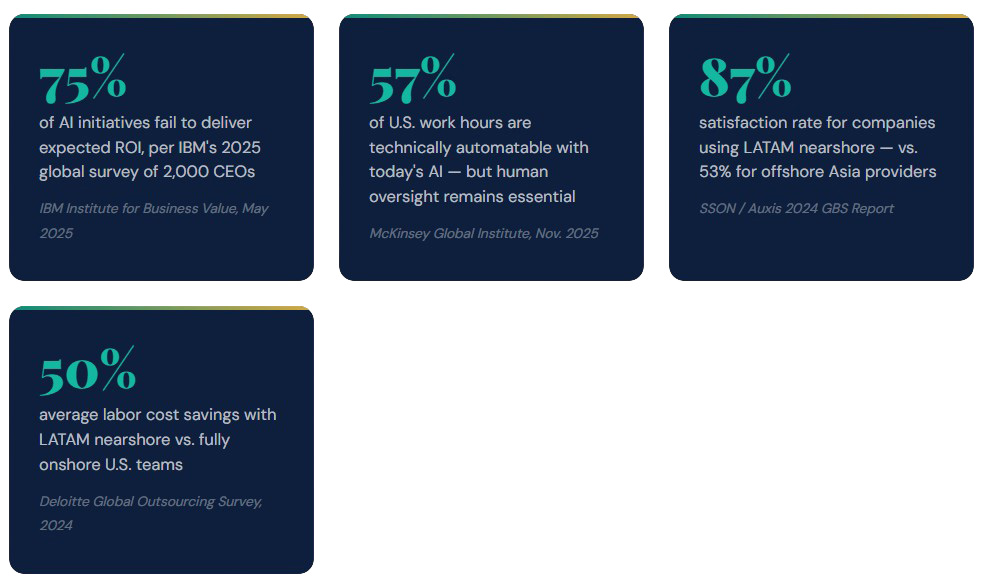
These figures together tell a decisive story. AI is real and powerful but it's automating tasks, not systems. The roles left in human hands are higher-stakes, more judgment-intensive, and more brand-sensitive than ever. And the data on nearshoring is unambiguous: LATAM-based teams outperform offshore alternatives on satisfaction, quality, and complexity of work performed.
Nearshore vs Onshore: What Actually Changed in 2026
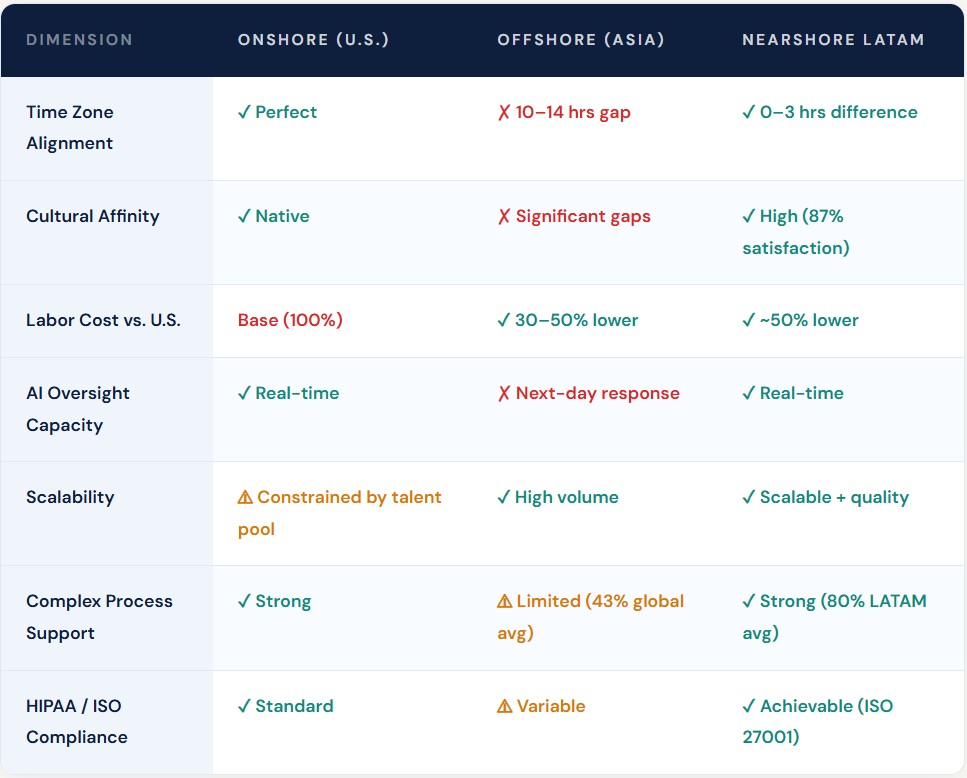
For years, the nearshore vs onshore conversation was primarily a cost discussion. Onshore meant quality; nearshore meant savings; offshore meant risk. That framework is obsolete. The question has evolved from "how much can we save?" to "where do the humans who supervise our technology need to sit?"
The answer depends on three variables that AI has made more critical, not less.
1. Decision Latency: The 12-Hour Problem
When your AI makes an error an incorrect insurance denial, a billing code hallucination, a flawed legal document the clock starts. The time between that error and a human correction is what we call Decision Latency. With an offshore team 10–14 time zones away, a 3 PM error in New York may not be addressed until the following morning. In healthcare revenue cycle or legal intake, that's not a delay, it's a liability.
Nearshore advantage:Colombia operates on Eastern Time (ET), meaning a Bogotá-based team shares your business hours, your standups, and your urgency. Real-time AI oversight requires real-time human availability. Nearshore delivers this at a fraction of onshore cost.
2. Cultural Fluency: What AI Can Translate vs. What It Can't
AI tools can translate 50 languages. What they cannot do is translate intent, tone, and professional context — the things that determine whether a medical denial appeal is worded correctly, or whether a legal intake call ends with a signed client. According to the 2024 SSON/Auxis State of GBS Report, over 60% of enterprise leaders cite "cultural affinity with the North American market" as a critical factor in choosing LATAM over Asia. The satisfaction differential — 87% vs. 53% — is largely driven by this alignment.
Latin American professionals, particularly in Colombia, share Western communication norms, U.S. business culture references, and the contextual judgment that makes high-stakes interactions land correctly. This isn't soft advantag it's operational risk management.
3. The Scalability Trap of Pure Onshore
Keeping all operations fully onshore in 2026 presents a different challenge: the combination of U.S. talent scarcity and rising labor costs makes scaling complex support functions prohibitively expensive. The 2024 Deloitte Global Outsourcing Survey found that "access to talent" overtook "cost reduction" as the #1 driver for outsourcing for the first time since the pandemic with only 34% of organizations still citing cost as their primary motivation, down from 70% in 2020.
The onshore model delivers quality. It cannot deliver scale. The nearshore model delivers both.
The HITL Standard: Why "AI First" Without Human Governance Fails
The IBM CEO Study from May 2025 surveying 2,000 executives across 33 countries found that only 25% of AI initiatives have delivered expected ROI in recent years, and only 16% have scaled enterprise-wide. The culprit isn't AI capability. It's the absence of proper human-in-the-loop (HITL) architecture.
McKinsey's 2025 report on agentic AI confirms the pattern: the organizations achieving real productivity gains including some banks reporting 60% efficiency improvements are those combining AI automation with structured human oversight, not those replacing humans wholesale.
The HITL model has a clear operational prescription: AI handles the high-volume, low-complexity tier; trained human specialists handle exceptions, validation, escalations, and anything touching brand trust or regulatory exposure. In healthcare revenue cycle management (RCM), this means AI processes claims while certified billing specialists audit denials in real time. In legal process outsourcing, AI handles document drafting while bilingual specialists review for compliance and nuance.
"The key takeaway is that AI should augment human agents not replace them. Automate the routine to drive efficiency, but always ensure customers have a clear, easy path to a human especially when emotions or complexity come into play." Industry analyst cited in CX Dive, May 2025
For this model to function at U.S. operating speed, the human layer must be available in your time zone, fluent in your professional context, and empowered to make real-time decisions. That is the operational case for nearshore over offshore and it is now backed by the data from Klarna, IBM, McKinsey, and the industry's own satisfaction benchmarks.
Why the "Third Path" Outperforms Both Extremes
The binary framing of outsourcing, choose cost savings (offshore) or choose quality (onshore) was always a false choice. The 87% vs. 53% satisfaction differential between LATAM nearshore and Asian offshore, documented in the SSON/Auxis 2024 report, demonstrates that the third path delivers both.
Vinali Group is a certified minority woman-owned U.S. business headquartered in Orlando, FL, with nearshore operations based in Bogotá, Colombia. Our operational model is built specifically around the HITL standard with specialist teams that function as a seamless extension of your U.S. operation, not a disconnected vendor relationship.
We operate across the verticals where AI governance and human judgment are most consequential:
Insurance companies are now deploying increasingly sophisticated AI to generate claim denials. Contesting those denials effectively requires human specialists who understand HIPAA regulations, payer-specific adjudication logic, and the strategic sequencing of appeals in real time, in your time zone. Our RCM teams operate on ET, meaning a denial issued at 2 PM is reviewed and contested before your billing day closes.
Document review, legal intake, and compliance work require professionals who can read context, not just content. Bilingual specialists in Bogotá who are trained to U.S. legal standards provide the judgment-layer that AI document tools cannot replace and do so at a cost structure that allows law firms to scale without inflating their overhead.
From executive support to insurance processing to finance and accounting, our virtual teams embed into your workflows with the cultural alignment and operational discipline that distinguishes a strategic partner from a staffing vendor.
The Vinali operating principle: AI is the engine. Our specialists are the pilots. And our Colombian operations hub means your pilots are always in the cockpit during U.S. business hours not catching up the next morning.
The Nearshore vs Onshore Question Has a Clear Answer in 2026
The Klarna story isn't cautionary because AI failed. It's cautionary because leadership made a strategic error: deploying automation without redesigning the human governance layer around it. The cost of that error included brand damage, customer attrition, and the expensive process of rehiring and retraining costs that never appeared in the original AI business case.
For U.S. companies in 2026, the nearshore vs onshore decision is no longer primarily a cost arbitrage question. It is a question of operational resilience in an AI-driven environment. The data is unambiguous: LATAM nearshore delivers real-time collaboration, cultural alignment, access to high-quality talent, and 30–50% cost savings compared to onshore all simultaneously. Offshore cannot match the first two. Onshore cannot sustain the last.
The companies winning in this environment aren't those who went all-in on AI and cut their human layer. They're the ones who understood that AI's value is unlocked by the quality of human oversight and invested in getting that oversight right.
The question for your business isn't whether to embrace AI. It's whether your human governance layer is positioned to make it work.
Klarna AI Announcement (Feb. 27, 2024): Klarna Press Release "Klarna AI assistant handles two-thirds of customer service chats in its first month." klarna.com
Klarna Rehiring Announcement (May 8–9, 2025): Bloomberg "Klarna Turns From AI to Real Person Customer Service." bloomberg.com; Fortune — "Klarna plans to hire humans again." fortune.com
IBM CEO Study (May 2025): IBM Institute for Business Value "2025 CEO Study: 5 mindshifts to supercharge business growth." 2,000 CEOs, 33 countries. ibm.com
McKinsey Automation Report (Nov. 2025): McKinsey Global Institute "Agents, Robots, and Us: Skill Partnerships in the Age of AI." fortune.com
McKinsey Generative AI (June 2023): McKinsey "The Economic Potential of Generative AI." 60–70% of work activity automation potential. mckinsey.com
The EOB is one of the most important documents in your revenue cycle. Here is what it contains, how to read it, and what happens when something goes wrong.
YOU ARE NEVER ON YOUR OWN WITH US. From day one, you get a dedicated expert by your side, guiding, optimizing, and making sure your business doesn't just run, but grows. Because your success isn't just our goal, it's our business.